


Dental Marketing Strategies I’d Use to Grow a Practice in 2026

Written by: Bera Niemczewski
I've seen dentists pour money into dental marketing and still feel like nothing sticks.
Dental marketing has changed a lot in the last few years, and most advice hasn't caught up.Dental marketing has changed a lot in the last few years, and most advice hasn't caught up.
I work with dental practices that are doing "all the right things" on paper.
- They have a website.
- They run ads.
- They post on social media.
- They invest in SEO.
Yet patient flow still feels inconsistent, and it is not always clear what is actually working.
The problem is usually not effort. There's a lot of effort, alright. It's usually (a lack of) structure.
In 2026, dental marketing strategies need to account for how patients actually search, decide, and book. Google Maps is often the first interaction. AI summaries shape expectations before a website visit. Reviews and videos influence trust more than polished copy. Mobile experience determines whether someone calls or leaves.
This guide is for you if:
- You want marketing strategies for a dental office that attract patients who are ready to book
- You're tired of guessing which channel deserves your time or budget
- You want clarity on how SEO, Google Maps, content, ads, and trust signals fit together
- You don't want hype. You want a system you can sustain
I'm writing this the same way I'd explain it to a dentist sitting across from me in a strategy session.
What to focus on first.
What to stop overthinking.
And what actually moves the needle for dental practices right now.
Let's break down the dental marketing strategies that actually grow practices in 2026, starting with the foundation most offices still underestimate.
My 2026 Dental Growth Stack
If you know me, you also know that growth is my favorite word. You can't do good marketing without taking that word into account.
Most dental marketing issues come down to sequence.
In 2026, effective dental marketing strategies follow a simple progression. A patient needs to find your practice, trust it, and have a clear, easy way to book.
Long-term growth comes from keeping that patient connected after the first visit.
This is how I structure marketing strategies for dental practices so each effort supports the next instead of competing for attention.
Recommended: Do You Still Need SEO in 2026?
Layer 1: Visibility (Maps + Search)
The goal here is simple. You need to show up when someone searches "dentist near me" and when they ask an AI-powered search result a question about dental care.
That starts with Google Business Profile completeness and consistency.
Accurate categories, fully filled services, current hours, regular photo updates, and active review responses all signal relevance and trust.

Google has been clear about this in its own guidance on how to improve your local ranking.Google has been clear about this in its own guidance on how to improve your local ranking.
Visibility also depends on local service pages that match real patient intent, such as emergency dentistry, Invisalign, or implants, and using "near me" language naturally, without forcing keywords or sounding robotic.
Dental marketing strategy #1: Treat Google Business Profile like your homepage
For most dental practices, Google Business Profile is the first interaction a patient has with your office.
Before they see your website, they see your profile in Maps.
That is where decisions start.
A strong profile is complete, current, and active. Accurate categories, fully filled services, regular photo updates, consistent hours, review responses, and a clear booking link all signal relevance.
When a profile is set once and left alone, visibility in Maps drops, even if the website ranks well.

My GBP checklist
- Categories: primary and secondary categories match your highest-value services
- Services: fully filled out, not partially completed
- Photos: updated regularly, ideally weekly
- Q&A: seeded with real patient questions
- Appointment link: always correct and tested
- Review replies: every review gets a response
The mistake I see constantly
"We rank number one organically, but we don't show up in Maps."
That usually means the Google Business Profile is under-optimized and inactive.
Organic rankings and Map visibility are related, but they are not the same system.
Dental marketing strategy #2: Build trust before the first phone call
Most patients decide whether they will contact a dental office before they ever pick up the phone.
They are not comparing credentials in detail.
They are looking for signs that the practice feels credible, clear, and safe.
Trust needs to be established quickly. Reviews and video do that faster than almost anything else.

Reviews are your digital handshake
Reviews are often the first piece of social proof a patient sees.
They influence both visibility and decision-making, which is why they cannot be treated as passive.
- Build a review request system instead of relying on staff to remember
- Reply to reviews in a consistent, human tone that reflects your practice
- Track review velocity monthly, not just your average rating
Patient behavior around reviews is well documented. Ongoing data consistently shows how much weight people place on recent feedback when choosing a local provider.
Video that actually converts
Video builds familiarity before a visit, which lowers anxiety and shortens the decision process.
- Short patient story clips, always with proper consent
- Simple explanations that answer cost, comfort, and recovery questions
- Team introductions that help nervous patients feel more at ease
Patients want to know what to expect and who they are walking in to see.
Dental marketing strategy #3: Your website should behave like a high-performing front desk
A dental website's job is not to impress. It is to help someone decide and take action.
If your site is slow, hard to read on mobile, or unclear about what to do next, marketing spend leaks quietly.
Traffic still comes in, but fewer visitors turn into calls or booked appointments. Most of the time, traffic is there. The problem is what happens after (hint: conversion)
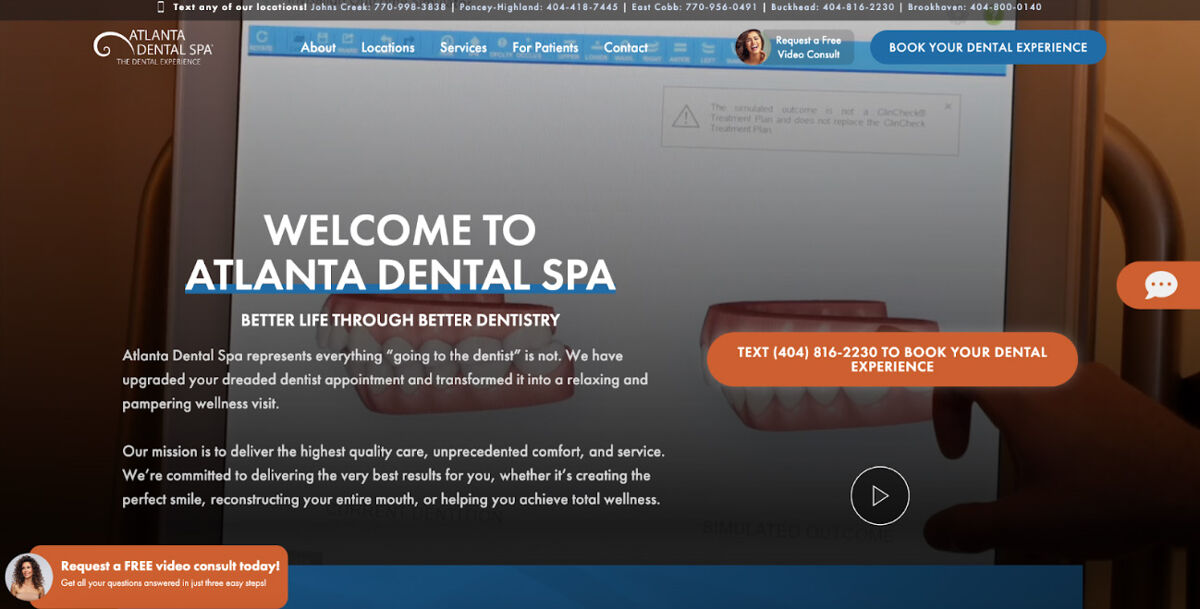
I evaluate dental websites the same way I evaluate a front desk. Can a patient get answers quickly, feel confident, and book without friction?
The 5-minute conversion audit I run
- Can a patient book an appointment in two taps on mobile?
- Is the phone number visible, clickable, and persistent while scrolling?
- Do key pages quickly answer cost, comfort, recovery, and time expectations?
- Is there proof above the fold, such as reviews, before-and-after photos, or credentials?
- Does each high-value service have its own focused page instead of being buried on one general page?
When these basics are handled well, every other channel performs better. This is where structured dental marketing solutions start to compound, because traffic has somewhere effective to land.When these basics are handled well, every other channel performs better. This is where structured dental marketing solutions start to compound, because traffic has somewhere effective to land.
Dental marketing strategy #4: Content that wins AI Overviews and organic search
Content works best when it mirrors how patients actually ask questions.
Short, direct answers first, followed by clear detail for anyone who wants to go deeper. This structure serves both real people and how modern search surfaces information.
Joycethedentist starts her blogs optimizing for featured snippet, answering the primary questions right away:Joycethedentist starts her blogs optimizing for featured snippet, answering the primary questions right away:
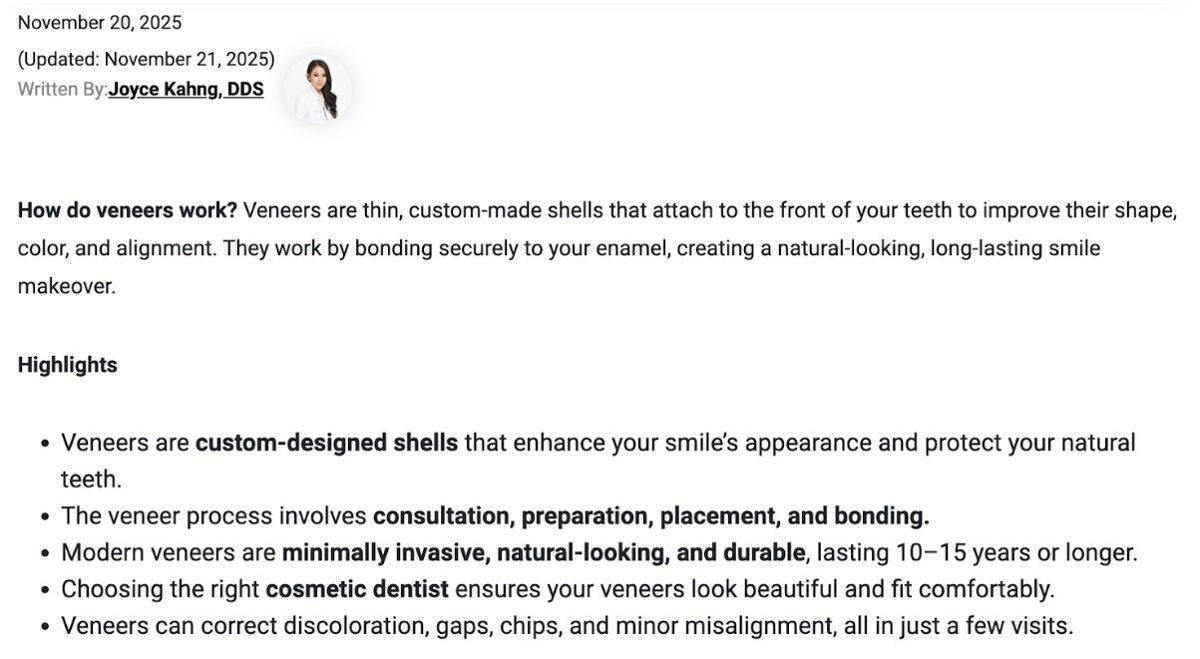
When content is written this way, it is more likely to appear in featured snippets, AI summaries, and voice search results, while still supporting organic rankings.
Our client is cited here for keyword purple legs because the content is easily understood by both AI and humans:

Here's a screenshot of the highlighted section that's performing extremely well:

The format that keeps getting picked up
- Question-style headings that match how patients speak
- A direct answer in the first paragraph
- Follow-up sections with steps, examples, common mistakes, and FAQs
This aligns with how Google evaluates pages for emerging search features, including AI features and how your website appears in search.
Content topics that actually drive revenue
Not all content attracts the same level of intent. The topics that convert tend to fall into three categories:
- Emergency intent: same day dentist in [city], urgent dental pain, broken tooth
- High-consideration intent: Invisalign vs braces, implant timeline, treatment costs
- Anxiety-based intent: sedation options, what a first visit is like, pain expectations
These topics answer real concerns at the exact moment patients are deciding whether to contact a practice.
Dental marketing strategy #5: Paid ads that support growth
Paid advertising can work well for dental practices, but only when it is structured around intent.
Problems usually start when ads are added randomly or treated as a replacement for organic visibility instead of a complement to it.
When paid media is planned correctly, it captures demand that already exists, reinforces trust, and supports the rest of your marketing efforts rather than competing with them.
My paid structure
I keep paid campaigns simple and layered, based on how ready someone is to book.
- Bottom funnel: Google Search campaigns focused on high-intent queries, such as emergency care or specific treatments
- Middle funnel: Retargeting that reinforces credibility through reviews, testimonials, and clear explanations
- Top funnel: Awareness campaigns centered on one core service at a time, never everything at once
This approach is how I structure PPC for dentists so ad spend supports patient acquisition without creating unnecessary waste.
Dental marketing strategy #6: Social media that leads to booked visits
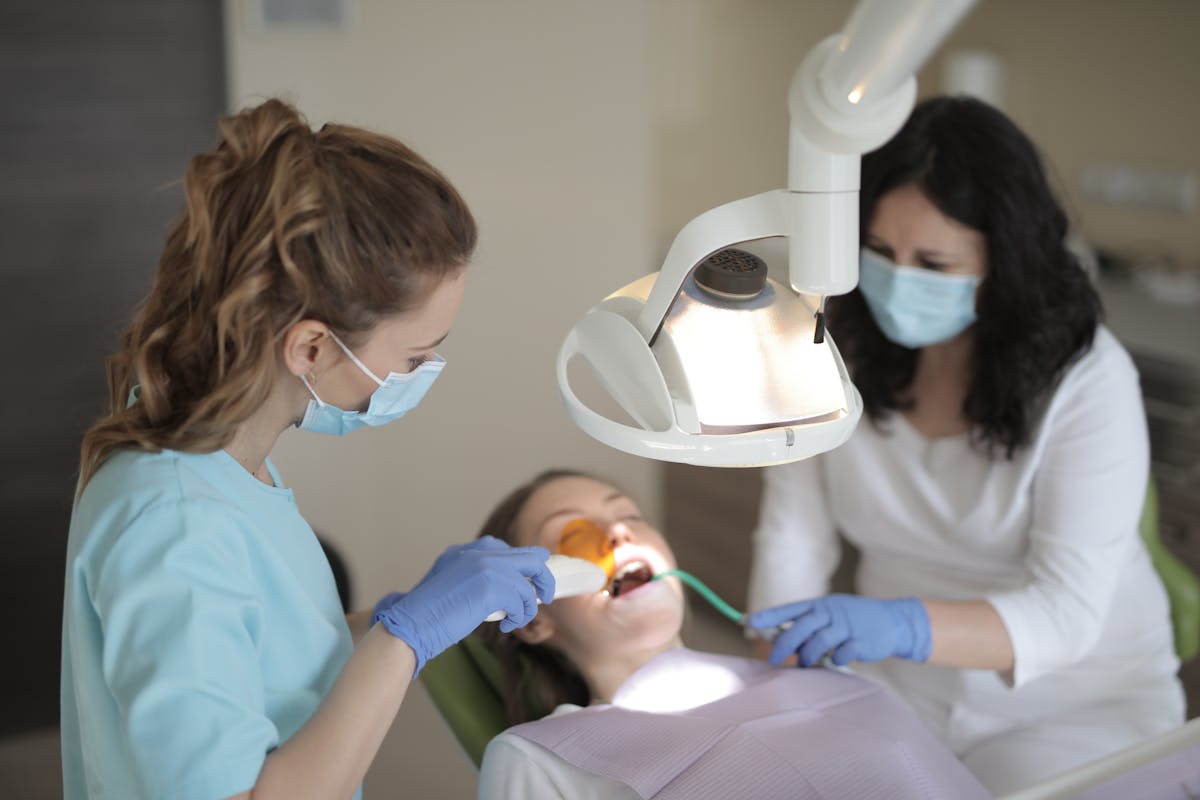
Social media works when it helps a patient decide whether they trust your practice and understand what to do next. If content never connects to scheduling or next steps, it may get engagement but it does not contribute to growth.
The worst scam I see online are "marketing agencies" promising reel views. You basically pay for views. Just views.
A dental practice is a local business. Imagine paying agencies for views in New York City when you're practicing in San Diego.
For dental practices, social media should support trust-building and decision-making. It should not be a standalone channel chasing views or likes.
My three content pillars
I keep social content focused on three areas that consistently move patients closer to booking:
- Education: clear answers to common questions, myths, and treatment concerns
- Proof: real results, testimonials, reviews, and outcomes
- Personality: team moments and behind-the-scenes content that makes the practice feel approachable
When these pillars are tied back to booking and visibility, social media marketing becomes a support channel that reinforces trust instead of a disconnected activity.
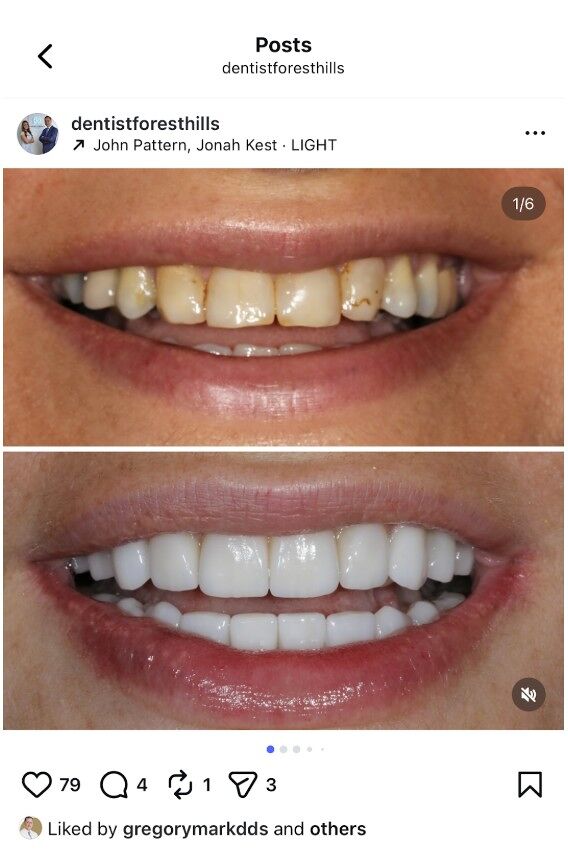
Remember, you don't need viral reels. You do need social media presence that books appointments and fills chairs.
Dental marketing strategy #7: Retention
Retention is one of those areas that rarely gets enough attention because it does not feel urgent. Most practices focus on bringing in new patients first and assume existing patients will stay.
That assumption usually costs more than people realize.
Patients who already know your practice are easier to rebook, more comfortable moving forward with treatment, and more likely to refer friends or family.
When retention is handled well, marketing pressure drops across the board.
Retention plays that actually matter
I keep retention simple and consistent. These are the areas that tend to make the biggest difference over time:
- Recall and reactivation: regular email and SMS reminders that keep patients connected without being intrusive
- Unscheduled treatment follow-up: clear, timely outreach for patients who left with pending treatment
- Referrals: straightforward prompts and scripts that make it easy for patients to recommend the practice
- Membership plan visibility: easy to understand, clearly explained, and present both in-office and online
None of this is complicated, but it has to be intentional.
When retention is working, new patient marketing becomes more efficient because you are not constantly starting from zero.
KPIs I track monthly
Marketing becomes frustrating when you are looking at the wrong numbers.
Traffic and likes can look good while patient flow stays flat, which usually leads to more spending instead of better decisions.
I track metrics that connect directly to appointments and follow-through. When these numbers are clear, it is much easier to see what is working, what needs adjustment, and where effort is being wasted.
KPIs I pay attention to
- Google Business Profile actions: phone calls, direction requests, and website clicks
- Organic performance: clicks to service pages, not just blog traffic
- Conversions: call clicks, form submissions, and booked appointments
- Speed to lead: how quickly someone receives a response after reaching out
- Reviews: new reviews per month and overall rating
These KPIs give a clearer picture of how marketing supports patient growth, without relying on surface-level engagement metrics.
A simple 7-day action plan
If everything feels overwhelming, this is where I usually start. The goal is not to do everything at once, but to put the most important pieces in place so the rest of your marketing has something solid to build on.
Day 1
Clean up your Google Business Profile. Check categories, services, hours, photos, and make sure the appointment link works.
Day 2
Build or refresh one high-value service page. Pick a service that drives revenue and patient demand, and make that page clear, focused, and easy to act on.
Day 3
Set up a review request system and give your front desk a simple script they can actually use.
Day 4
Record three short videos in an FAQ style. Answer common questions patients ask about cost, comfort, timing, or what to expect.
Day 5
Launch one paid search campaign, or fix tracking and structure on the one you already have.
Day 6
Set up a retargeting ad that uses proof, such as reviews or testimonials, to reinforce trust.
Day 7
Create a simple KPI view and decide how often you will review it each month.
Where to focus if you want real momentum
Most dental practices do not need more ideas. They need clarity on what to fix first and what will actually move patient flow.
If you take anything from this guide, let it be this: marketing works best when the basics are solid and connected. Visibility in Maps. Trust signals that feel real. A website that makes it easy to book. Follow-up that does not rely on memory.
When those pieces are in place, everything else performs better.
If you are unsure whether your current website is helping or holding things back, that is often the fastest place to get clarity.
We offer a FREE dental website build for practices that qualify, specifically for offices whose sites are outdated, underperforming, or no longer reflect how patients search and decide today.We offer a FREE dental website build for practices that qualify, specifically for offices whose sites are outdated, underperforming, or no longer reflect how patients search and decide today.
Whether you start by improving one page, fixing one system, or reassessing the role your website plays in your marketing, progress usually begins once the structure is clear.
Ready to build a marketing growth machine?
Let's create momentum that lasts.
Book your strategy session with 1flowww.
Book Your Free Consultation