

What Are Google Review Mentions? (A Dentist's Guide to Getting Found)

Written by: Bera Niemczewski
Two dental practices.
Same 4.8-star rating.
Same "dentist near me" search.
But one of them has bolded phrases sitting right under the listing ("pain-free injections," "same-day crowns," "great with anxious patients") and that's the one getting clicked.
That's Google Review Mentions doing exactly what it's designed to do.
And most dentists have never heard of it.
Google Review Mentions are specific keywords, phrases, or topics from patient reviews that Google's AI surfaces and bolds in your listing to help searchers instantly understand what your practice is known for.
In this post, you'll learn exactly how they work, what types exist, and, most importantly, how to influence what Google highlights so your listing starts doing the selling before a single patient clicks through.
What are Google Review Mentions?
Google Review Mentions are the bolded keywords and clickable topic tags that appear on your Google Business Profile, pulled directly from the language your patients use in their reviews.
You can say they’re doing the SEO work for you.
Google runs two mechanisms here.
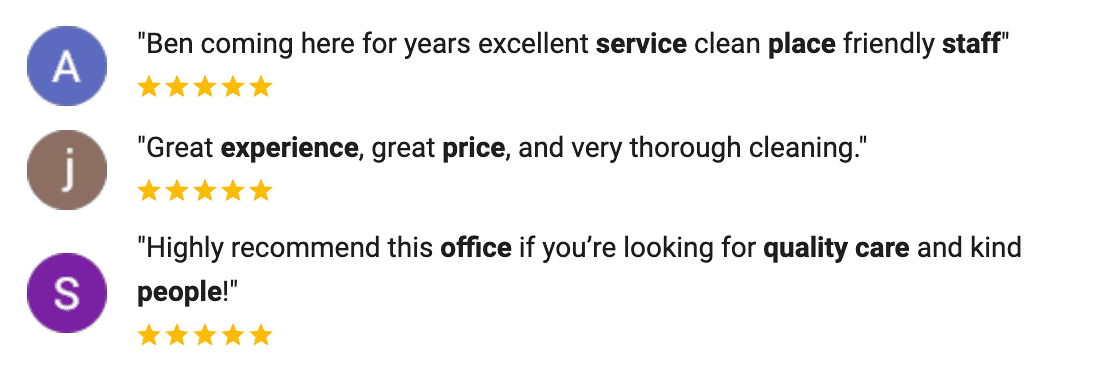
The first is Review Snippets, which are the most commonly mentioned words and phrases from reviewers, surfaced in bold. They're immediately visible to anyone browsing your listing.
The second is Place Topics. Those are clickable tags generated from recurring keywords in your reviews, which patients can tap to filter and read only the reviews relevant to that theme.
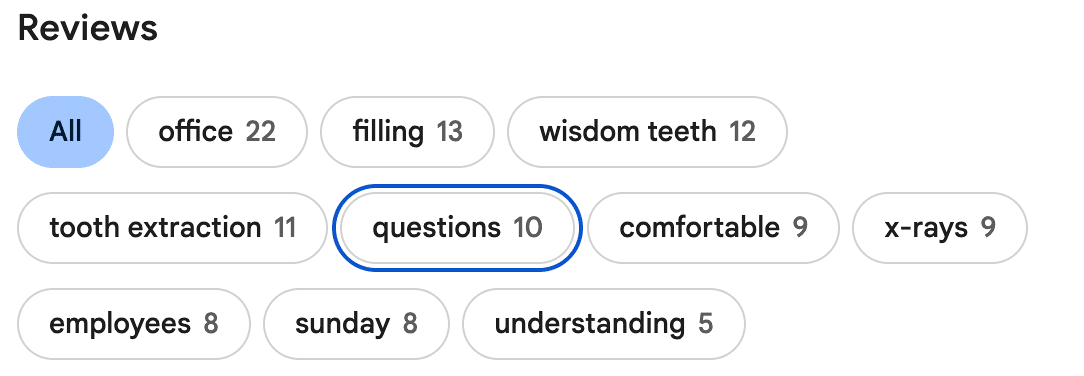
Think of a prospective patient tapping "dental implants" to pull up every review where someone mentioned their implant experience.
Here is the part most dentists miss: you do not write or submit any of this. These tags and snippets are algorithmically generated.
It means Google decides what appears based entirely on the patterns it finds in your patients' actual words.
Google is essentially reading every review you receive, finding what comes up again and again, and deciding which phrases best represent your practice to the next searcher.
Then it puts those phrases front and center in Maps and Search.
You cannot manually control which phrases get highlighted. But you absolutely can influence what shows up, and that is exactly what we cover here.
3 Types of Google Review Mentions
There are three types of Google Review Mentions that show up on your listing, and each one works a little differently.
Type 1: Place Topics
Place Topics are automated, AI-generated tags that summarize the most common themes across your reviews.
They only appear once your practice has enough patient feedback, and Google manages them entirely.
You do not set them up.
You do not approve them.
Your only job is to generate enough genuine reviews for Google to find a pattern worth tagging.
A practice where dozens of patients have mentioned "Invisalign" in their reviews may eventually see "Invisalign" appear as a clickable Place Topic on their profile.
The same goes for "teeth whitening," "sedation dentistry," or "emergency appointments."
Whatever your patients keep coming back to.
Type 2: Service-Specific Mentions
When enough patients describe a specific procedure in their reviews, Google treats that as a relevance signal.
It reinforces what your practice does and helps your profile surface for those searches.
This is where the SEO value gets real.
A patient writing "Dr. Chen fixed my cracked molar with a same-day crown" is not just leaving a nice review. She is telling Google your practice does same-day crowns, and Google is listening.
Type 3: Location and Context Mentions
When patients reference your neighborhood, a nearby landmark, or a surrounding area in their review, it strengthens your geographic relevance for those specific searches.
A review that says "best dentist in the Wicker Park area" helps you show up when someone in Wicker Park searches "dentist near me."
For practices in competitive cities where dozens of offices sit within a few miles of each other, these location mentions can be the difference between making the Map Pack and sitting just outside it.
How do Google Review Mentions affect local SEO?
Google Review Mentions improve your local search visibility by helping Google match your listing to the exact service a patient is searching for.
It also gives that patient an instant reason to click your profile over a competitor's.
Here is how the mechanism works:
Google uses AI to scan your reviews, extract the themes that keep coming up, and match them against what a nearby patient is actually searching for.
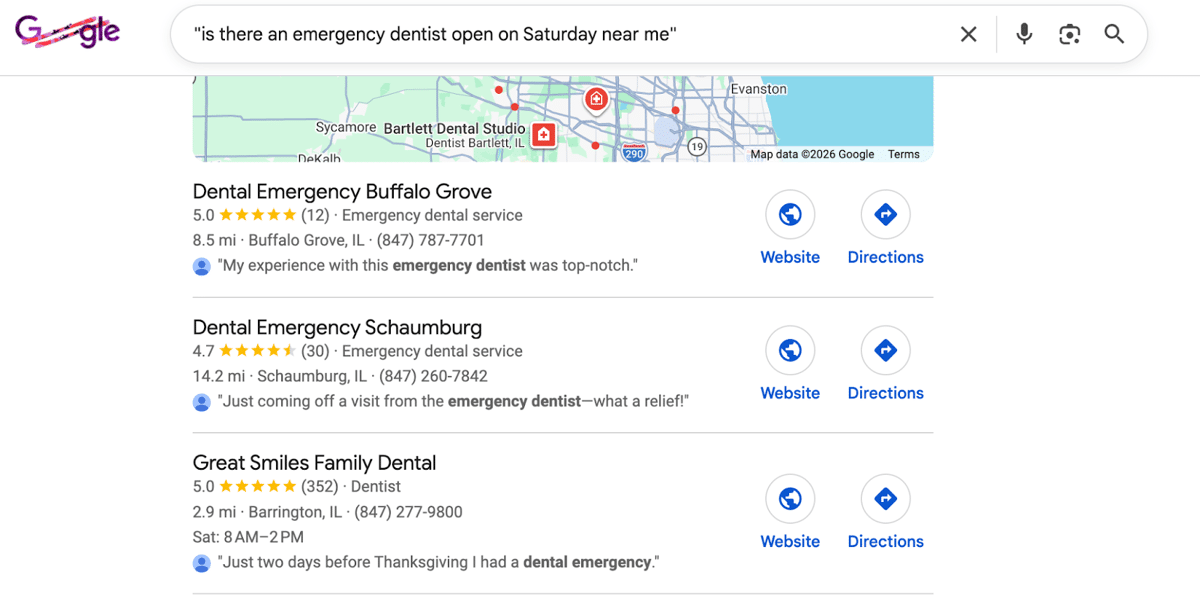
Someone asking "is there an emergency dentist open on Saturday near me" who sees "emergency appointments" and "open weekends" bolded on your listing is far more likely to click than on a listing with nothing but a star rating.
The ranking impact is real.
Reviews account for roughly 10% of local SEO ranking factors.
Appearing in the Google 3-pack drives significantly more traffic and patient actions than landing in positions 4 through 10.
Review Mentions are one of the levers that get you there.
But the SEO benefit only tells half the story.
Reviews that mention specific treatments, staff names, and measurable outcomes generate notably more patient inquiries than generic comments.
Detailed reviews drive higher consultation conversion rates than star ratings alone.
A bolded "pain-free injections" or "great with anxious patients" answers the question most dental patients are silently asking before they ever read a single full review.
We are, after all, becoming a more and more scannable population.
This is also where your broader marketing starts to compound.
If your practice is running Google Ads for dentists or investing in local SEO, review mentions are what close the gap between a paid click and a booked appointment.
A patient who lands on your Maps listing after clicking an ad and sees nothing but a number and some stars is far easier to lose than one who sees exactly what they were hoping to find, already bolded and waiting for them.
How do you get better Google Review Mentions?
You cannot tell Google what to highlight, but you can shape the raw material it works with.
Here’s how to do it without crossing any lines.
Ask your patients for specifics
The request "please leave us a review" produces generic feedback.
The request "if you are happy with your Invisalign consult today, a quick Google review mentioning what we talked about would mean a lot to us" produces the kind of review Google actually surfaces.
Train your front desk and hygienists to name the procedure in the ask.
Timing matters too. Request within hours of a successful appointment, not days later when the details have faded.
Respond to reviews with natural service language
Responding to reviews gives Google another piece of business-generated content tied to your profile.
Including service terms naturally in responses reinforces your relevance for those keywords.
Thanking a patient for trusting you with their crown replacement is useful. Packing five procedure names into a two-sentence reply is not.
One or two natural service references per response is the sweet spot.
Note: It is very important that you do not share any information in your response that is non-compliant with HIPAA.
Build volume consistently
A steady, consistent flow of reviews signals to Google that your practice is active and relevant.
But a burst of old feedback followed by silence works against you.
Google needs enough reviews mentioning a topic before it generates a Place Topic or Snippet for it.
There is no shortcut around that threshold.
Aim for 50 or more reviews and a reliable weekly cadence rather than a one-time push.
Make it easy for patients to be specific
Do not just send a review link. Send a review prompt.
A short SMS after an implant appointment that reads "We hope everything went smoothly today. If you have a moment, sharing your experience on Google would help us so much" gives patients a frame to write from.
How do you find your Google Review Mentions?
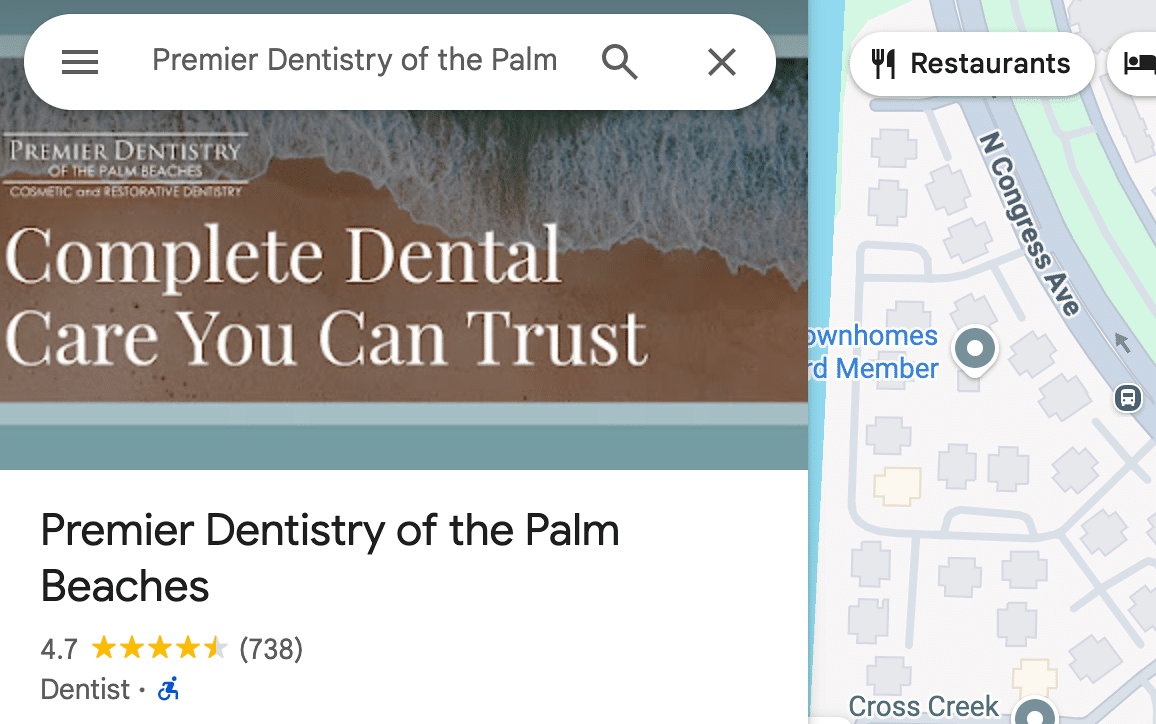
I’ll show you how to find the review mentions step-by-step using a Palm Beach practice (not our client). They’re doing well on Map Pack.
Open Google Maps and type your practice name (you have to do it via Google Maps in order to search the reviews for keywords):

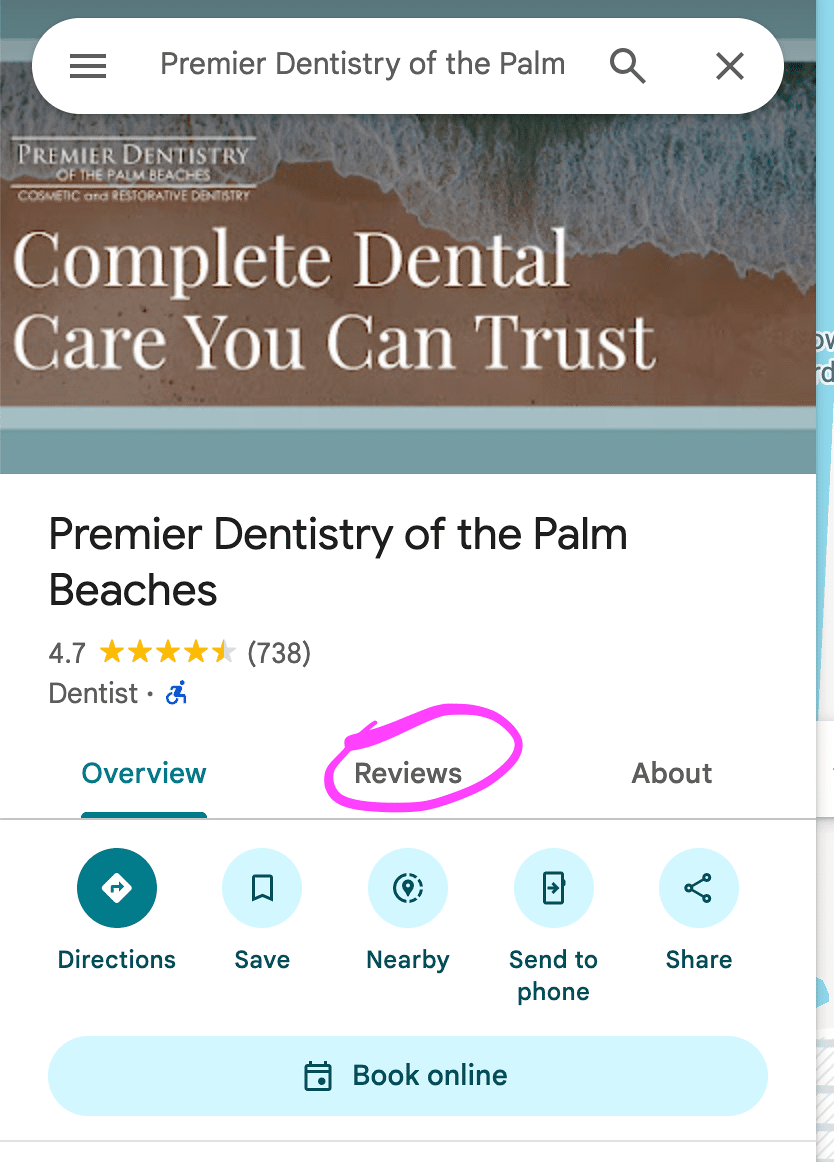
Click the Reviews tab:
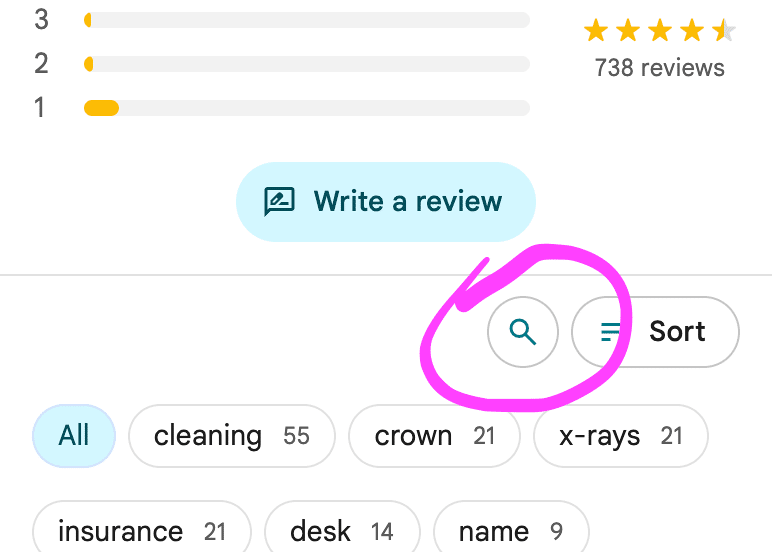
Tap the magnifying glass icon:
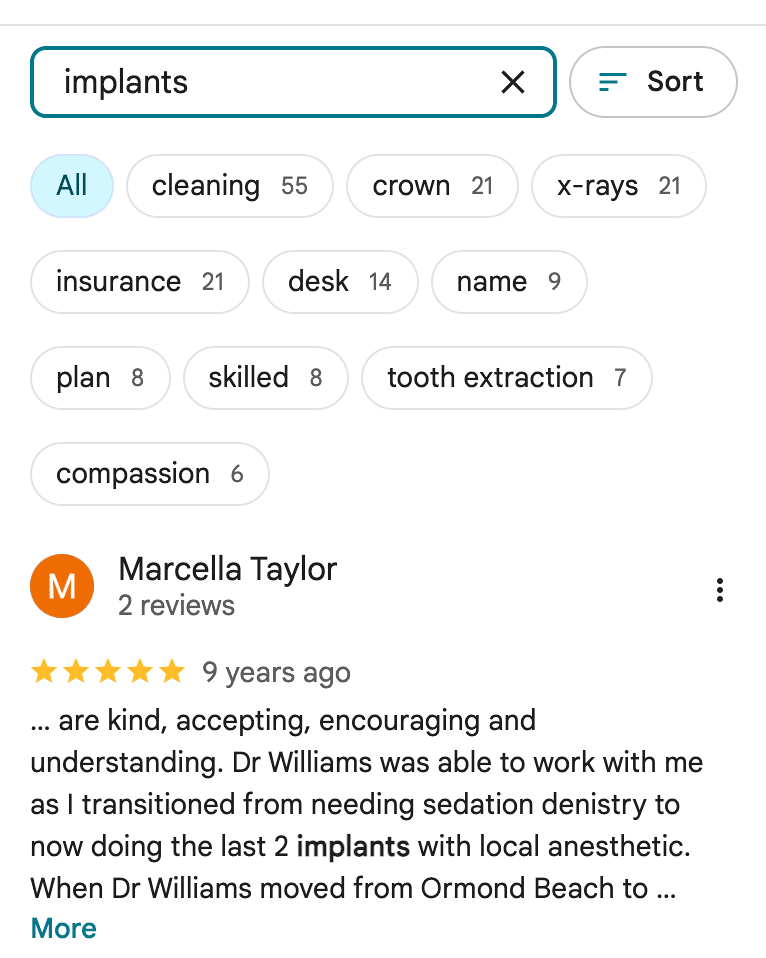
Type any word or phrase and Google surfaces every review containing it, with that term bolded.
Start with your core services, like "implants," "Invisalign," "whitening," "emergency" and see what comes back.
Once you are in there, use what you find to answer three questions.
What are patients already praising?
That is your strongest signal.
If "gentle with needles" keeps showing up, that phrase belongs in your Google Ads copy, on your homepage, and in your Instagram captions.
Your patients handed you your best marketing language for free.
What services are never mentioned?
Authority work focuses on earning legitimate local mentions and links that reinforce trust.
If nobody is writing about your same-day crowns, one of two things is true: the experience is not memorable enough to prompt a comment, or you are not asking patients to mention it.
Either way, now you know.
Are there any negative patterns?
A recurring complaint spotted early is worth more than any PPC campaign spent trying to overcome a reputation problem later.
If three patients in the last month mentioned "long wait times," that is a operations conversation.
One more move worth making: run the exact same keyword searches on your top two or three local competitors and:
1. see what their patients keep praising
2. spot the gaps their reviews reveal
3. build your positioning around what they are clearly not delivering
That is competitive intelligence most dental practices never think to collect, and it costs nothing but ten minutes.
If you need a free audit of your practice, send me an email at bera@1flowww.com or reach out online.
Common Mistakes Dentists Make with Google Reviews (That Kill Mentions)
Asking for a 5-star review instead of a specific experience.
"Please leave us a 5-star review" produces "Great dentist, highly recommend!"
Google will not bold that. It has nothing to work with.
Ask patients to mention what they had done, and you get the raw material that actually becomes a snippet.
Only asking happy patients.
This feels safe but backfires.
A practice with 200 reviews averaging 4.4 stars regularly outperforms one with 50 reviews averaging a perfect 5.0.
A mix of ratings signals authenticity.
A flawless score with low volume signals suspicion, to Google and to patients.
Never responding to reviews.
Businesses that respond consistently tend to receive reviews more frequently.
Responses that include service-specific language reinforce what your practice does in Google's eyes.
Silence reads as indifference, both to prospective patients and to the algorithm.
Letting volume stagnate.
A practice with 120 reviews and nothing new in three months loses to a competitor with 60 reviews coming in every week.
Recency is a ranking signal. A steady trickle beats a one-time flood every time.
Offering incentives.
Discounts, gift cards, free whitening in exchange for a review.
All of it violates Google's policies.
The consequence is the potential removal of every review your practice has ever earned.
It is not worth it.
The Bigger Picture
Google Review Mentions do not work in isolation. They are one layer of a local SEO strategy that also includes:
- a fully optimized Google Business Profile
- consistent citations across directories
- website content that backs up what your reviews are saying
Each piece reinforces the others.
The search landscape is also shifting in a direction that makes all of this more urgent.
Google is now curating answers for patients rather than simply listing websites.
It means that practices whose content and reviews clearly signal expertise in specific services are more likely to surface in AI Overviews and Map Pack results.
If your reviews and your website are both consistently mentioning "sedation dentistry" or "pediatric dental care," Google has more confidence pointing patients your way.
The modern patient journey looks something like this:
● a voice search or "near me" query leads to a Maps listing
● review mentions answer the unspoken question
● the click becomes an appointment
Every part of your digital presence needs to support that path, from your web design to your review strategy to how your Google Ads are written.
Speaking of ads: if your practice is running PPC campaigns, review mentions are what convert the traffic those ads are paying to send.
Stop Leaving Your Reviews to Chance
Google Review Mentions are not a passive feature.
They are built from the specific language your patients use, shaped by how consistently you ask, and amplified by how actively you respond.
The practices winning the Map Pack have a system.
This week, open Google Maps, pull up your practice profile, click into your reviews, and search your top three services. What shows up? That is your starting point. What is missing is your next move.
If you want to go deeper, explore how your Google Business Profile optimization, local SEO strategy, and patient communication all connect.
Because review mentions are just one piece of a practice visibility strategy that, when it works together, runs on autopilot.

Ready to build a marketing growth machine?
Let's create momentum that lasts.
Book your strategy session with 1flowww.
Book Your Free Consultation