

Effective Strategies for Attracting New Dental Patients Online

Written by: Bera Niemczewski
Attracting new dental patients used to mean running a Yellow Pages ad and hoping for the best.
Not anymore.
Today, it's a combination of strategies:
✅ local SEO
✅ Reviews
✅ your website
✅ paid ads
✅ social media
Each one is working together to bring new patients through your door.
The good news? You don't need to do all of them at once.
You just need to start with the right ones.
Here's exactly what works.
How Do I Get My Dental Practice to Show Up in Local Search?
When a potential patient searches "dentist near me," Google serves up three local results before anything else.
That's the local pack. And if you're not in it, you're invisible.
Local SEO is how you get there.
How Do I Optimize My Google Business Profile for My Dental Practice?
Your Google Business Profile (GBP) is the single most important local SEO asset you have.
It's free.
And most practices set it up once and never touch it again.
That's a mistake.
Here's what a fully optimized profile looks like:
📍 Claim and verify your profile if you haven't already
📍 Set your primary category to "Dentist" (not "Medical Clinic," not "Health & Wellness")
📍 Complete every section: hours, services, accepted insurance, and photos of your office and team
📍 Write a business description that naturally includes your city and key services (e.g., "We offer general and cosmetic dentistry in [City], including teeth whitening, Invisalign, and same-day emergency care")
Pro tip: According to Google, businesses with complete profiles are significantly more likely to get direction requests and calls than incomplete ones. Every empty field is a missed opportunity.
Why Does NAP Consistency Matter for Dental SEO?
NAP stands for Name, Address, and Phone number.
It needs to match exactly everywhere your practice appears online:
➤ Google
➤ Yelp
➤ Healthgrades
➤ Facebook
➤ every directory listing you're in
Even small differences hurt you. "Suite 100" on one site and "Ste. 100" on another is enough to confuse search engines and quietly drag down your local rankings.
Run a quick audit. Check that your practice name, address, and phone number are identical across every platform.
Fix anything that doesn't match.
What is the Most Cost-Effective Google Ads Strategy for Dentists?
Google Ads can get expensive really fast.
Click after click, no appointment booked. The costs add up.
Local Service Ads (LSAs) work differently. And for most dental practices, they're a smarter place to start.
How Do Local Service Ads Work for Dental Practices?
LSAs appear at the very top of Google search results.
Above the regular ads.
Above the local pack.
Above everything.
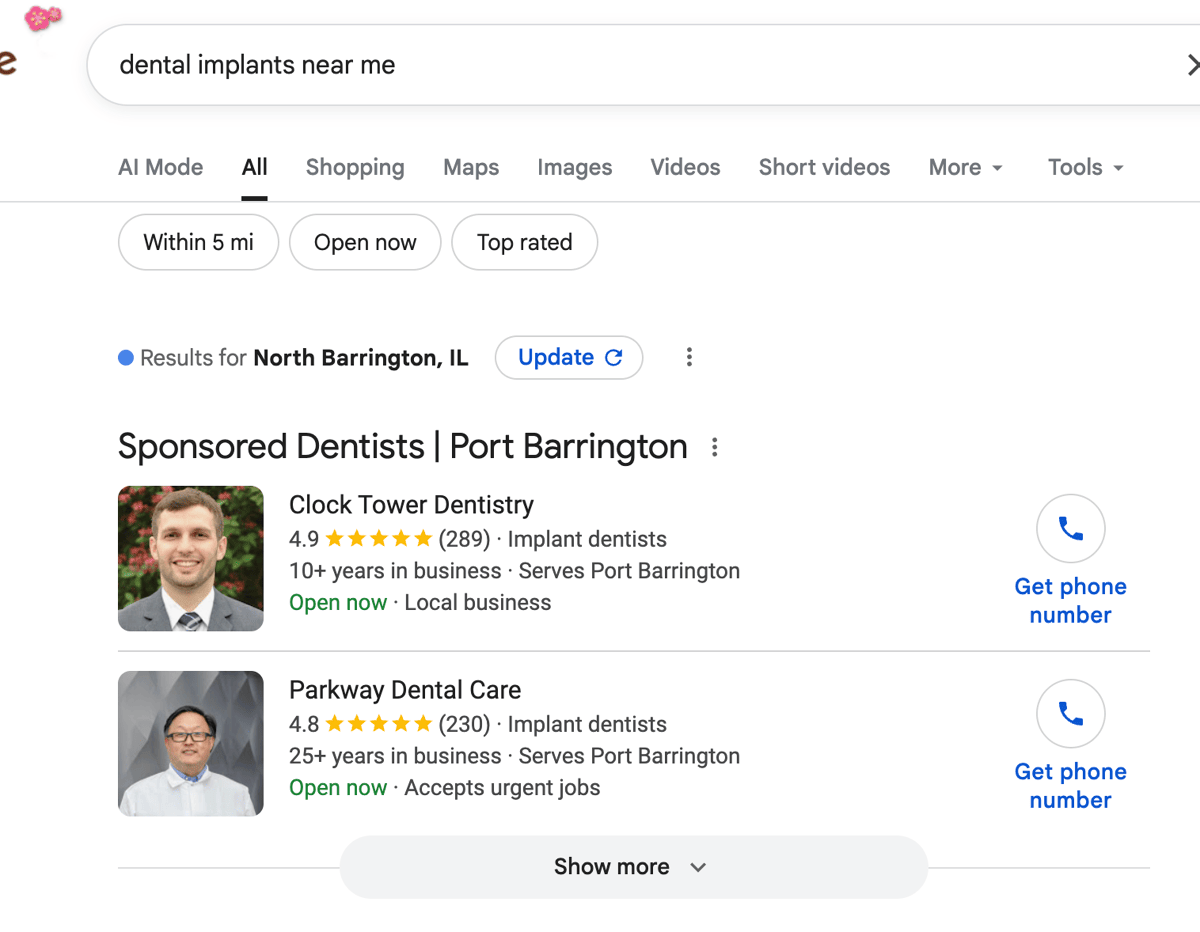
And here's what makes them different: you only pay when a patient actually contacts you. Not per click but per lead.
That alone makes them more cost-effective than traditional Google Ads for most small practices.
But there's another advantage.
LSAs display your photo and star rating directly in the search results, before a patient ever visits your website.
First impressions happen right there on the page.
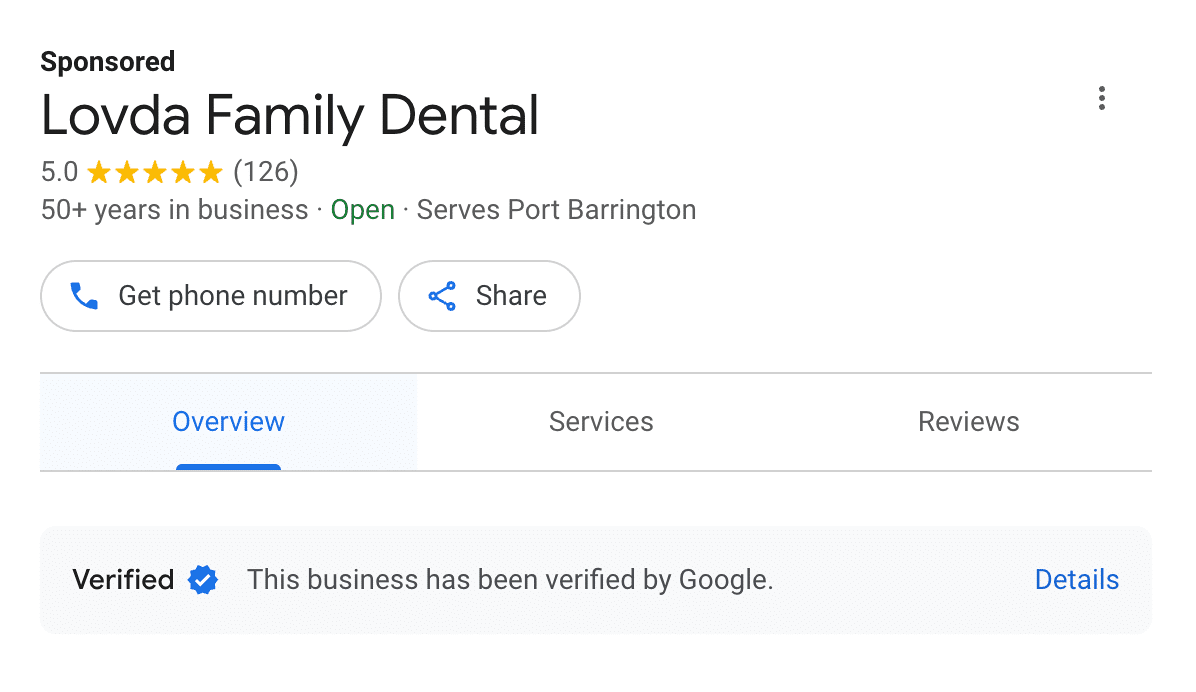
Practices that go through Google's verification process also earn the Google Verified badge. It’s a visible trust signal that tells new patients you've been vetted.
What Makes a Good Dental Website in 2026?
Your website is the first place most patients go before they ever pick up the phone.
If it's slow, confusing, or looks like it was built in 2010, they might leave and book with someone else.
A good dental website does three things:
○ loads fast
○ works on mobile
○ makes booking an appointment effortless
What Features Should Every Dental Practice Website Have?
Mobile-responsive design: Over 60% of dental searches happen on mobile. If your site doesn't work on a phone, you're losing more than half your traffic.
Fast load times: If your site takes more than 3 seconds to load, patients bounce. Google knows this and ranks slower sites lower.
Online booking: Patients expect to schedule without calling. If they have to pick up the phone, many won't. An online booking button should be visible on every page.
Clear service pages: Dedicate individual pages to your core services: cleanings, implants, Invisalign, emergency care. This helps with SEO and helps patients find exactly what they need.
Trust elements: Photos of your team, your credentials, and a quick office walk-through video make your practice feel real before someone walks in.
Think of your website as your best front desk staff member. It's working 24/7, answering questions, and booking appointments while you sleep.
How Do Online Reviews Help Dentists Get New Patients?
New patients trust other patients.
A five-star Google review from someone in their neighborhood carries more weight than any marketing campaign you could run.
Reviews are social proof. And in dentistry (where trust is everything), they're your most powerful marketing tool.
How Do I Get More Google Reviews for My Dental Practice?
The practices with the most reviews have a system.
Here's what that system looks like:
Ask right after a positive appointment. Don't wait a week. Ask while the patient is still happy and the experience is fresh.
Send a follow-up text or email with a direct review link. Make it easy. Don't make them search for your Google page. The fewer steps, the more reviews you'll get.
Train your front desk to ask naturally. Scripted requests feel awkward. A simple "If you're happy with your visit today, we'd really appreciate a quick review" works better than a corporate pitch.
Focus on these platforms:
● Google (most important, as this is where patients search first)
● Yelp (especially in urban areas)
● Healthgrades (where patients compare providers)
Should I Respond to Negative Reviews?
Yes. Every single one.
Responding to reviews (good and bad) signals that you're active, engaged, and care about your patients' experience.
For negative reviews, keep it professional and brief.
Thank them for the feedback, apologize for their experience, and invite them to contact you directly to resolve the issue. Don’t argue or get defensive.
Potential patients read your responses (not just the review itself).
A calm, professional reply to a 1-star review can actually build trust. It shows you handle problems with care.
Your response is often more valuable than the review.
Does Social Media Really Bring in New Dental Patients?
Yes, but only if you're posting the right content on the right platforms.
You don't need to be everywhere.
The practices that do well on social media don't post daily motivational quotes.
They post content that builds trust before a patient ever books an appointment.
What Should Dentists Post on Social Media?
Here's what actually works:
Before-and-after photos (with patient consent). These get the highest engagement and show real results. A smile transformation is more convincing than any ad copy.
Educational short videos. Answer one question per video. "How often should you really floss?" "Is teeth whitening safe?" Keep them under 60 seconds. Patients share useful content.
Staff spotlights. Introduce your hygienists, assistants, and front desk team. New patients feel more comfortable when they recognize faces before walking in.
Behind-the-scenes content. Show your office, your technology, your morning routine. It humanizes your practice and makes you feel accessible.
By the way, you don’t need to go viral. In fact, focus on targeting the local audience, even in your social media posts. Don’t fall for those ads that claim they’ll get you views.
Views don’t pay your bills. Booked chairs do, and no one is flying from Boston to see you in Orange County (unless you’re a superstar!).
Which Social Media Platforms Should Dentists Use?
Focus on three:
Facebook is best for local reach and community engagement. It's also the best platform for running paid ads to nearby patients.
Instagram works for visual content and attracts a younger demographic. Use it to showcase smile makeovers and short educational clips.
TikTok is surprisingly effective for educational dental content. Short, helpful videos about oral health perform well and reach people who aren't actively searching for a dentist yet.
Should Dentists Run Paid Ads on Social Media?
Yes, if you want to fill your schedule faster.
Organic social builds trust.
Paid social drives appointments.
The key is targeting patients in your immediate area with an offer that gets them to book now.
How Do I Run Facebook and Instagram Ads for My Dental Practice?
Start with hyper-local targeting. Here's the setup:
Target by location.
Set a radius around your practice (3 to 10 miles, depending on your area).
Then layer in demographics like age range and interests (parents, health-conscious, new movers).
Lead with a clear offer.
Free new patient consultation.
$99 cleaning and exam.
No offer means no urgency. Give them a reason to book today instead of later.
Use video ads.
They consistently outperform static images.
A 15-second video of your office or a patient testimonial will get more clicks and appointments than a stock photo.
Retarget website visitors who didn't book.
These are warm leads. They already know who you are.
A retargeting ad reminding them to schedule converts at a much higher rate than cold traffic.
One more thing: be specific. An ad that says "Serving [Your City] families since 2005" will always outperform a generic "Looking for a dentist?" headline. Local trust beats broad messaging every time.
How Do I Get More Patient Referrals for My Dental Practice?
Your happiest patients are your best marketers.
They just need a nudge.
Word-of-mouth referrals convert at a much higher rate than cold ads. These are warm leads with built-in trust. Someone they know already vouches for you.
How Do I Set Up a Referral Program for My Dental Practice?
Keep it simple. Complicated referral programs don't get used.
Here's what works:
Offer an incentive
Give the referring patient a discount on their next visit, a gift card, or account credit. Make it worth their effort to spread the word.
Reward both sides
The referrer gets a benefit, and the new patient gets a discount or free consultation. This makes the referral feel generous.
Make it easy to share
Give patients a referral card they can hand out, or send them a text or email with a shareable link. If they have to explain the program themselves, most won't bother.
Announce your referral program at checkout, in appointment reminder emails, and on a dedicated page on your website.
Does Content Marketing Work for Dental Practices?
Yes. Blog posts and videos do two things:
They bring in organic search traffic. And they position you as the expert patients want to see.
Content marketing is about answering the questions potential patients are already searching for.
What Content Should Dentists Create to Attract New Patients?
Focus on three types of content:
Answer real patient questions.
- How much does Invisalign cost?
- Is teeth whitening safe?
- Do I really need my wisdom teeth removed?
These are high-volume searches. If you rank for them, you own that traffic.
Create location-specific content.
- Write posts like "Best dentist in [City]" or "Dental implants in [Neighborhood]."
Local keywords help you show up when people search for services near them.
Address dental anxiety.
Fear keeps people out of the dentist's chair. Content that talks about:
- sedation options,
- what to expect during a cleaning, or
- how you handle nervous patients removes a major barrier.
Keep your formats simple:
Blog posts should be:
- 800 to 1,200 words
- target one specific question
- answer it clearly in the first paragraph, then add detail below
Videos work best when they're short. One question, one answer, under 90 seconds. Post them on YouTube and Instagram.
The goal is to show up when someone in your area searches for what you offer.
Dominate the dental industry in your area
You don't need to do all of this at once.
Start with what's most broken. For most practices, that's local SEO and reviews.
Fix those first. Then layer in paid ads, social media, and content over time.
The practices that do great online aren't the ones doing the most.
They're the ones doing the right things consistently.
We offer a free consultation to go over the issues your practice is facing, whether it’s online, offline, or operational. To schedule yours, reach out to Vince at vince@1flowww.com

Ready to build a marketing growth machine?
Let's create momentum that lasts.
Book your strategy session with 1flowww.
Book Your Free Consultation